
M.A. Sociology (MASO) – Complete Guide | Master of Arts in Sociology
If you are interested in understanding society, social change, inequality, globalization, and contemporary social issues, the M.A. Sociology (MASO) programme is an excellent postgraduate option. This programme is offered by Indira Gandhi National Open University (IGNOU) under the School of Social Sciences (SOSS).
The course is designed in line with the NEP 2020 framework, aiming to provide advanced sociological knowledge and research skills to a wide range of learners, including students from remote and underserved areas.
About the M.A. Sociology (MASO) Programme
The M.A. Sociology (MASO) is a two-year postgraduate programme divided into four semesters. The curriculum is comprehensive and contemporary, covering both classical sociological theories and modern social realities.
The programme focuses on:
- Sociological Theories and Concepts
- Research Methods and Perspectives
- Social Development Processes
- Global, Regional, and Local Social Linkages
- Contemporary Social Issues
It prepares students to critically analyze social structures, institutions, and processes shaping modern society.
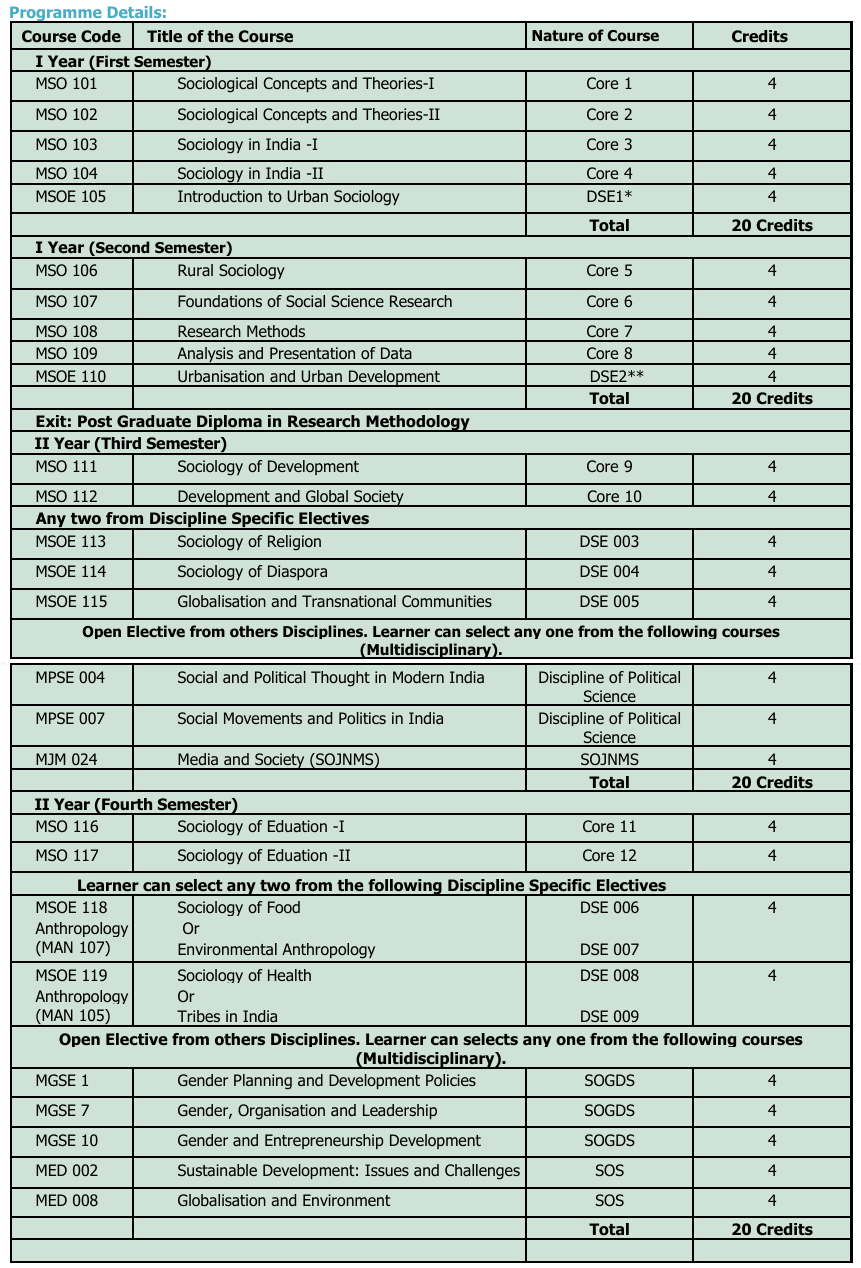
Key Areas Covered in MASO
-
Sociological Theories and Methods
- Classical sociological thinkers
- Contemporary sociological thinkers
- Research methodologies to understand social phenomena
-
Social Processes and Global Linkages
- Interconnection of local societies with regional systems
- Impact of globalization
- Global social structures and linkages
-
Development and Social Change
- Socio-economic structures
- Political processes of development
- Patterns of social transformation
-
Sociology of Health and Medicine
- Role of medicine in society
- Concept of health
- Medical pluralism
- Sociology of development in health systems
-
Sociology of Food and Agriculture
- Social structures related to food
- Social inequalities
- Agro-ecological aspects of food practices
-
Rural Sociology and Urbanization
- Rural development
- Migration
- Education
- Urbanization
- Globalization
-
Diaspora and Transnational Communities
- Socio-cultural dynamics of diaspora communities
- Transnational social networks
Eligibility Criteria
To apply for M.A. History (MAHI), candidates must have:
- A Bachelor’s Degree or higher degree from a recognized university.
There is no restriction on the undergraduate discipline. Students from any academic background can apply.
Career Opportunities After M.A. History
An M.A. in History opens doors to various career paths:
- Teaching & Academics
- School Teacher (with B.Ed.)
- Assistant Professor (after qualifying NET/PhD)
- Civil Services & Competitive Exams
- UPSC
- State PSC
- SSC
- Other Government Examinations
- History is an important subject for civil services preparation.
- Research & Policy Making
- Research Associate
- Policy Analyst
- Think Tanks & NGOs
- Media & Journalism
- Political Analyst
- News Researcher
- Content Writer
Admission Process
Admissions are generally conducted twice a year (January and July sessions).
The process usually involves:
- Online registration
- Uploading required documents
- Payment of programme fees
There is typically no entrance examination, and admission is based on eligibility criteria.
Why Choose M.A. History (MAHI)?
- UGC-recognized and widely accepted degree
- Affordable fee structure
- Flexible study schedule
- Ideal for working professionals
- High-quality self-learning material
- Helpful for competitive exam preparation
Conclusion
The M.A. History (MAHI) programme is more than just a postgraduate degree. It provides a deeper understanding of historical processes, social transformations, and political developments. Whether you aim to pursue teaching, research, civil services, or media careers, this programme offers a strong academic foundation.
If you are passionate about history and want a recognized, flexible, and affordable postgraduate degree, M.A. History (MAHI) is a smart choice.